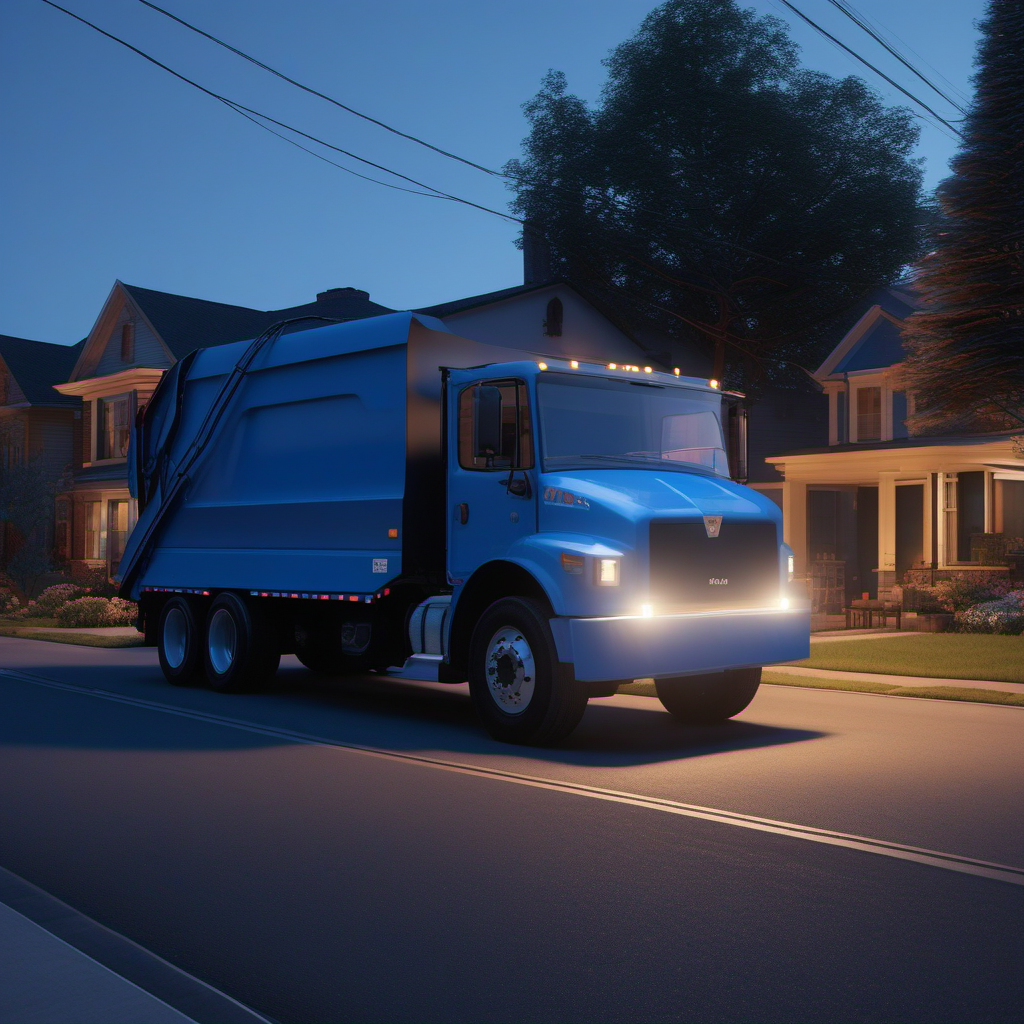
The garbage truck rolls down a Dallas street. It stops at the curb. A high-resolution camera on the side of the truck photographs the houses it passes. It captures driveways, front yards, peeling paint, overgrown grass. Software scans every image for violations. It assigns each property a score - The Blight Score.
The Blaze reported on this system on September 19, 2026. Dallas partnered with a tech firm called City Detect to put AI cameras on ordinary garbage trucks. The cameras photograph homes as the trucks make their rounds. Algorithms look for overgrown lawns, structural disrepair, and discarded junk. The system produces a "blight score" for each property.
City Detect says the software blurs human faces and license plates before storing the imagery. The house, the driveway, the lawn, and the property itself can still be photographed, analyzed, and flagged. The company says the blur protects identity. The property owner gets no such protection.
The grandmother in the Dallas story put it plainly. "When you think you've hit rock bottom," she said, "always remember that hell has a basement."
We are in that basement.
Act I. The Patriot Act, 2001
The arc did not start with a garbage truck. It started in 2001, with the Patriot Act.
Congress passed the law weeks after the September 11 attacks. It expanded wiretaps and financial monitoring. Supporters framed it as a reasonable price for safety. The trade was presented as simple: give up some privacy, get protection in return.
That first trade normalized surveillance as a cost of citizenship. It taught Americans that being watched was a fair exchange. The government needed tools to find threats. The tools came with little public debate about where they would stop.
The Patriot Act was aimed at "the bad guys." Terrorists, in the official telling. The language of the law was broad, but the public story was narrow. The monitoring would target people who meant harm.
That framing mattered. It set the pattern for everything that followed. Every new surveillance tool would arrive wrapped in the same promise. It would only touch the people who deserved it. It would leave everyone else alone.
The promise never held.
Act II. License Plate Readers, 2010s
The next step came a decade later. License plate readers spread across American cities through the 2010s.
The pitch was familiar. The cameras would catch stolen cars. They would help with Amber Alerts. They were a tool for public safety, pointed at criminals.
The cameras did more than that. They read every plate that passed. They logged the time, the location, and the vehicle. They built a searchable database of every car that drove through a monitored area.
Police can query it to see where a car was on any given day. The system records innocent drivers and suspects alike. There is no filter for wrongdoing at the point of capture.
The trade was still framed as reasonable. Catch stolen cars, the pitch said. The cost was a permanent record of where everyone drove. Most cities accepted it without much argument.
The ratchet turned one more notch. Surveillance aimed at "the bad guys" now swept up every driver. The database did not care who was innocent.
Act III. Doorbell Cameras, 2015-2020
Then the cameras came to our own porches.
Doorbell cameras spread through American neighborhoods between 2015 and 2020. The pitch was different this time. It was not the government asking. It was us, buying the cameras ourselves.
The selling point was simple. Your own camera on your own porch. You can see who rings the bell. You can check your doorstep from anywhere. It is your house, your camera, your choice.
The choice became a shared grid. Police departments began asking homeowners for footage. Then the police made a deal with Ring. They can seize any Ring footage at any time. Doorbell camera networks gave officers a way to tap into thousands of private cameras on demand. A crime happens on one street, and police can request clips from every camera in the neighborhood.
Ring and its competitors leaned into this. They marketed the cameras as neighborhood watch tools. They built partnerships with police departments. The footage flowed from private porches to public records.
We did this to ourselves. No law required the doorbell cameras. No government mandate put them on the houses. We bought them, installed them, and pointed them at the street. Then we handed the footage over.
The step mattered because it changed the story. Surveillance was no longer something the state imposed. It was something citizens welcomed. The doorbell camera made being watched feel like safety. It made the watcher feel like a neighbor.
The ratchet turned again. Each step made the next one easier, because each step taught the same lesson. Surveillance is normal. It is aimed at someone else. Resistance is futile.
Act IV. Flock Cameras, 2020s
The doorbell cameras were private. The next step was corporate, and it was everywhere.
Flock Safety built a network of license plate cameras that now covers much of the country. The company markets them as simple plate readers. The pitch: they catch stolen cars and help solve crimes.
The cameras do more. In September 2026, a group of hackers called stegan0gram pulled down a Flock camera, opened it, and copied its data. They handed the data to tech outlets. Wired and 404 Media reported on what they found.
The software on the device explicitly detects people. It does not just read plates. It detects people, vehicles, license plates, and bicycles. The firmware runs about 20 built-in apps that handle motion detection, photos, uploading, and updates.
The camera takes 28 to 100 photos when something moves into view. It captures different exposures. One exposure reads the license plate. Another captures the wider environment around the vehicle.
Wired and 404 Media analyzed 21 days of logs from the device. The logs covered more than 50,000 vehicles and 1.6 million images. The camera logged 3,300 to 4,500 vehicles per day. Every 2 minutes, an operational check logged the phrase "Who's a good boy?!" The check appeared more than 12,000 times.
The system also makes mistakes. It cropped an American flag patch on a rider's saddlebag and treated it as if it were a license plate. The misidentification shows how the system guesses at what it sees.
Flock now operates roughly 140,000 cameras. An estimated 81 percent of the license plate reader market belongs to Flock. The company built a movement-tracking grid with little public oversight.
The company's response to the hack was predictable. It said removal and tampering are illegal. It encouraged people to report vulnerabilities. It did not address the core finding, which is that the cameras detect people, not just plates.
The pitch said "just license plate readers." The hardware says otherwise. The gap between the pitch and the product is the whole story.
Act V. The Garbage Truck, Postal Service, and School Bus Today
Every act before this one had a justification. The Patriot Act had terrorism. The plate readers had stolen cars. The doorbell cameras had neighborhood safety. Flock had crime solving.
The garbage truck, USPS truck, and School Bus have none of that.
Garbage Trucks
Dallas put AI cameras on its garbage trucks with City Detect. The cameras photograph homes and yards as the trucks roll through residential neighborhoods. The software scores each property for blight. Overgrown grass, peeling paint, and structural disrepair all count against the score.
The system needs no suspicion. It needs no complaint. It photographs every property it passes, whether or not the owner has done anything wrong. The government does not react to a problem. It scores everyone in advance.
The citizen-government relationship is inverted here. The state no longer waits for wrongdoing. It evaluates every resident on a schedule. Your front yard is a data point.
City Detect says the software blurs faces and plates. That detail does not change the core problem. The property itself is still photographed, analyzed, and ranked. The person who lives there is still scored.
USPS Trucks
The postal service is moving the same direction. 404 Media reported on September 30, 2026 that the USPS is running a pilot to put cameras in mail carrier trucks. The cameras continuously scan roads and signs. They map roadways and sidewalks. The stated purpose is "community safety."
The pilot uses Next Base dashcams. It covers 100 vehicles in the DC area. It started September 21 and will run for several months. The cameras record up to 4K and capture every license plate with precision. The trucks already have 360-degree cameras that capture the area outside the vehicle.
A USPS spokesperson called it a "limited pilot to assess whether vehicle-mounted cameras can help identify roadway conditions and support community safety." The pilot has no ALPR software. The cameras still record everything they see.
School Buses
The school bus is the newest stop on the same route. Connecticut towns are installing AI-powered license plate readers on school buses. The Associated Press reported on the program on September 9, 2026.
More than half a dozen towns have contracted with a company called BusPatrol. The company installs the technology on bus fleets, then gathers footage of any motorist passing a bus with its flashing red lights displayed. The recordings go to local law enforcement.
BusPatrol says the cameras are not continuously monitoring roads. They trigger only when a school bus stops with its warning lights and stop arm engaged. The company says its child safety systems are regulated by the state where they are installed.
New Haven installed the technology on more than 300 buses earlier this year. The cameras have already recorded 12,000 incidents. In Vernon, the cameras caught almost 100 motorists passing school buses in the first three days of the program.
The stated purpose is safety. Passing a stopped school bus is dangerous, and enforcement has long been weak. Connecticut has recorded 12 fatalities and 23 serious injuries involving school buses over the last six years. The fine for a first-time camera-caught violation is set at $250.
The privacy concern is the same one that runs through every act of this story. The cameras connect to a system that logs plates and shares footage. Residents worry the video could reach federal immigration enforcement or other databases that use AI to search for people.
Dan Piper, an organizer for the CT Civil Liberties Defense Committee, put it plainly. "I think AI cameras on school buses should be banned, just as all AI cameras in the state and in the country should be."
Connecticut has become the state with the most ALPR cameras per capita in New England. Municipalities and businesses have installed nearly 800 of them. Governor Lamont called for a 30-day pause on new installations while the state develops guidance on data retention and sharing. The pause did not specifically cover school bus cameras.
The garbage truck is the symbol of this whole arc. It is the most mundane vehicle in American life. It comes to every house, every week, without fail. Nobody thinks about it. Nobody questions it. It is just the garbage truck.
Now it is an AI surveillance platform.
We did not vote for this. We did not notice it. The cameras went on the trucks, and the trucks kept running their routes, and the software kept scoring the houses. The change happened without a public decision.
That is the basement. Not the wiretap. Not the plate reader. Not the doorbell. The garbage truck.
The Ratchet
These five acts were not separate decisions. They were one machine.
Each step made the next easier. The Patriot Act taught Americans that surveillance was a reasonable cost. The plate readers taught them that a permanent record was acceptable. The doorbell cameras taught them that being watched felt like safety. Flock taught them that a private grid could cover the whole country. The garbage truck taught them that no justification was needed at all.
The direction never reverses. It flows one way, from "the bad guys" to everyone. Each new tool starts with a narrow target and expands to the whole population. The expansion is never rolled back.
The ratchet is the mechanism. Every act normalizes the next one. Once a tool exists, the next tool is easier to sell. The public has already accepted the premise. The new camera is just one more step.
The Stakes of Unaccountable AI
The garbage truck raises a separate problem. The cameras are only half the story. The software that reads the images is the other half.
AI systems make confident mistakes. On September 18, 2026, Zero Hedge reported on a near miss inside the Pentagon. A human analyst used AI-generated data for a report. The report circulated across classified channels.
The chatbot hallucinated nuclear weapons components aboard a Chinese vessel bound for Iran. The false report set off the highest alerts. A special forces boarding operation was imminent. Assets were airborne.
The operation was halted only after officials discovered the report was AI-assisted. One unnamed official said the assessment was "entirely false" and "almost started a war."
The analyst had queried a chatbot about a ship's manifest. The bot fused open-source data with signals intelligence. It produced a confident, detailed, and entirely wrong answer. The system did not flag its own uncertainty.
A former senior US official described the internal tools bluntly. "The internal tools are mostly just copies of the commercial stuff wearing lipstick", the official said.
Officials are pushing to weave AI into nearly every facet of intelligence work. The same pressure applies to domestic surveillance. The garbage truck camera feeds a scoring algorithm. The algorithm decides what counts as blight. The algorithm makes the call.
An AI that hallucinates nuclear components can also hallucinate a blight violation. It can misread a pile of leaves as structural disrepair. It can flag a house that did nothing wrong. The score goes on the record with no human review and no appeal.
The Dallas system scores properties automatically. The scoring is the product. The resident never sees the calculation. The resident never gets to contest it. The camera photographs the house, the algorithm assigns the number, and the number becomes the record.
The Governments Demanding Access
The appetite for this data is not limited to Texas. Governments are pushing for the same access in the digital world.
The UK government tried to force Apple to build a backdoor into iCloud. The Washington Post reported in January 2025 that the Home Office issued a technical capability notice to Apple. Apple did not comply. It pulled Advanced Data Protection from UK users instead.
The dispute reached the Investigatory Powers Tribunal in London. Ben Jaffey KC represents Privacy International and Liberty. In September 2026, the tribunal heard the case. The government's "neither confirm nor deny" stance on the backdoor was called "farcical" in court.
Apple is in court trying to force the government to confirm the notice exists. The government refuses to say whether it issued one. The secrecy itself became the issue.
Tulsi Gabbard said in August 2025 that the UK agreed to "drop its mandate" for the Apple backdoor. A second, narrower notice followed in October 2025. It aimed at UK users. WhatsApp and Google confirmed they received no such orders.
The pattern is the same as the garbage truck. The government wants the data. The tool gets built quietly. The public finds out later, if at all. The demand for access never shrinks.
The Basement
The grandmother in the Dallas story was right. Hell has a basement.
The basement is the garbage truck, the USPS truck, and the School Bus. They are the most ordinary vehicles in American life, quietly converted into an AI surveillance platform. It needs no suspicion, no complaint, and no justification. It just scores you.
The wiretap required a warrant. The plate reader required a camera on a pole. The doorbell required a homeowner to buy it. The Flock camera required a company to install it. The garbage truck required nothing but a contract and a route.
Nobody is pretending it is for your safety anymore. The doorbell cameras at least made that claim. The plate readers made that claim. The garbage truck does not even bother. It is just scoring you.
The arc ran from the Patriot Act to the blight score. Each step made the next easier. The direction flowed one way, from "the bad guys" to everyone. The last step needed no justification at all.
The Dallas grandmother said it best. "When you think you've hit rock bottom, always remember that hell has a basement."
The garbage truck is the basement. Your front yard is a data point. The camera is already rolling.
Sources
The Blaze. "In this big Texas city, garbage trucks have joined the surveillance state." September 19, 2026. theblaze.com
Wired and 404 Media. "Vandals got hold of a Flock camera, instead of destroying it, they revealed what's inside." September 18, 2026. theblaze.com
Zero Hedge. "WW3 Near-Miss? AI Hallucinated Nuclear Weapons Components Aboard Chinese Vessel Bound For Iran." September 18, 2026. zerohedge.com
Reclaim The Net. "UK Government's Apple iCloud Backdoor Secrecy Called 'Farcical' in Court." September 18, 2026. reclaimthenet.org
404 Media. "USPS To Put Cameras in Trucks That Scan Roads for 'Community Safety'." September 30, 2026. 404media.co
Associated Press / Connecticut Mirror. "Connecticut towns are installing license plate reading cameras on school buses." September 9, 2026. apnews.com